
If your Odyssey just squealed through the school pickup line or the brake pedal feels softer than usual, you’re likely overdue for new pads. The Honda Odyssey is a heavy minivan, often loaded with passengers, cargo, and gear, which puts real stress on its braking system year-round.
The average Honda odyssey brake pad replacement cost runs between $150 and $380 per axle, depending on the shop, the pad brand, and whether your model year has an Electronic Parking Brake on the rear. That wide range is the reason this guide exists: to show you exactly what drives the price, what your specific generation needs, and how to avoid the costly mistakes shops see every week.
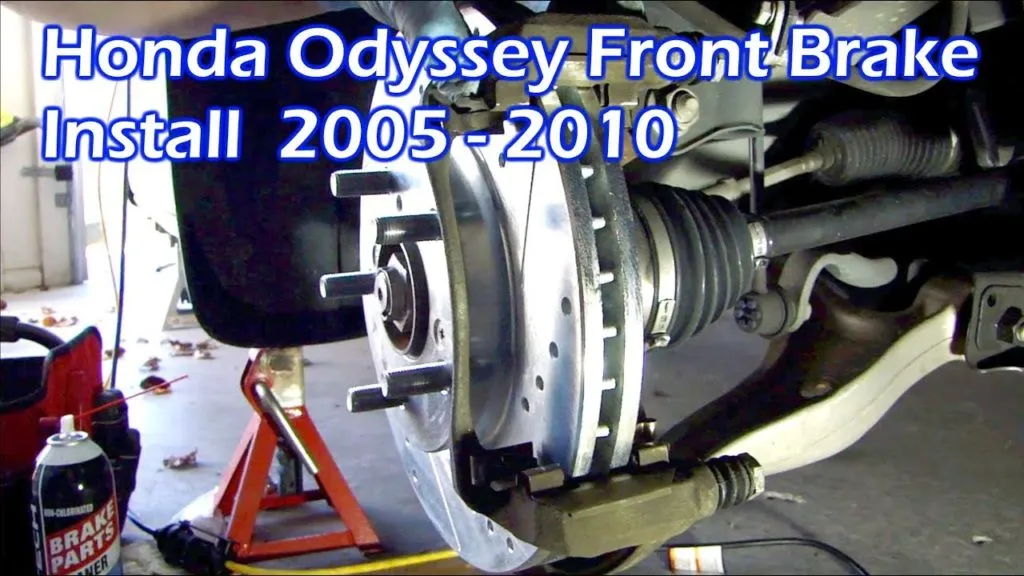
2011-2017 Honda Odyssey Front Brake Pad Replace DIY
What Affects the Cost of Honda Odyssey Brake Pads?
Three factors move the price more than anything else.
- Pad material: Ceramic pads, which Honda fits from the factory, run $80 to $150 per axle for quality aftermarket sets. Budget semi-metallic pads start under $40, but they wear faster and produce significantly more brake dust.
- Front vs. rear: Front and rear pads are priced similarly for parts, but rear labor on 2018 and newer Odysseys costs more due to the Electronic Parking Brake system, which requires a scan tool or a manual spindle retraction step before the caliper piston can be compressed.
Shop type: Independent shops typically charge $80 to $120 per hour in labor. Honda dealerships run $130 to $180 per hour. On a standard pad swap taking 1 to 1.5 hours per axle, that difference adds up fast, especially if the shop determines you need a full caliper replacement and you need to know exactly what is a semi-loaded brake caliper versus just swapping the pads.
Use our Free Auto Repair Cost Estimator to calculate the expected repair cost based on your vehicle issue.
Use the Repair Cost Estimator
Honda Odyssey Brake Pad Replacement Cost by Generation
| Generation | Model Years | Parts Cost (Per Axle) | Labor Cost (Per Axle) | Total Per Axle |
| 5th Gen | 2018 to 2025 | $90 to $150 | $120 to $180 | $210 to $330 |
| 4th Gen | 2011 to 2017 | $80 to $130 | $100 to $150 | $180 to $280 |
| 3rd Gen | 2005 to 2010 | $70 to $110 | $90 to $130 | $160 to $240 |
These estimates are for ceramic pads at an independent shop. Dealership pricing typically runs $60 to $100 higher per axle.
Honda Odyssey Brake Pads and Rotors Replacement Cost
Rotors on the Odyssey are a known weak point, particularly on the front axle. Owners on the OdyClub forum report warped front rotors appearing as early as 30,000 miles, often presenting as a pulsating brake pedal or steering wheel shimmy at highway speeds. When that happens, replacing pads alone will not fix the vibration.
The honda odyssey brake pads and rotors replacement cost for a full front axle job typically runs $350 to $550 at an independent shop, or $500 to $750 at a dealership. Rear axle rotor and pad replacement adds $280 to $480 depending on labor complexity from the EPB system.
As a rule: if the rotors have developed grooves deeper than 1mm, are below minimum thickness, or have visible heat bluing, replace them alongside the pads. (If you are measuring them yourself, be sure to verify exactly what is the minimum thickness for brake rotors before reusing them).
Resurfacing is rarely cost-effective on the Odyssey because the rotors are relatively thin to begin with, and turning them leaves even less material to absorb braking heat.
If your brake system has triggered any warning codes post-repair, see the guide on how to fix the service safety restraint system for what those flags mean and what the repair involves.
The 2018+ EPB Warning: What Every Odyssey Owner Needs to Know?
The fifth-generation Odyssey introduced an Electronic Parking Brake on the rear calipers. This is the single most important thing to understand before authorizing a rear brake job on a 2018 to 2025 model.
On a standard caliper, you push the piston back with a C-clamp (if you are unfamiliar with this standard DIY method, see our quick guide on how to use a c-clamp for brakes ). On an EPB caliper, the piston is mechanically linked to an electric motor. Forcing the piston back without first retracting the EPB spindle will destroy the actuator, turning a $250 rear brake job into a $600-plus repair.
There are two correct methods to retract the EPB before pad replacement:
- Method 1 (preferred): Use an OBD2 scan tool with Honda EPB service mode. Tools like the Autel MaxiAP AP200, available for around $60, command the rear motors to retract electronically. Turn the ignition on with the engine off, navigate to EPB maintenance mode, and confirm retraction before touching the caliper.
- Method 2 (manual, no scan tool): Remove the two T30 Torx screws holding the EPB actuator to the caliper. Pull the actuator back and use a large flathead screwdriver on the exposed spindle teeth. Turn clockwise until it reaches a full stop. This retracts the piston mechanically and safely.
After the new pads are installed, reset the EPB by cycling the parking brake on and off twice with the ignition on but the engine off. The red brake indicator on the cluster should extinguish.
Any shop working on your 2018+ Odyssey rear brakes that does not mention EPB procedure is worth questioning before they begin.
Unusual Wear Pattern: Why Odyssey Rear Pads Often Wear First?
Most drivers expect the front pads to wear faster because front brakes handle the majority of stopping force. On the Honda Odyssey, the opposite frequently happens, and real-world owner data from OdyClub confirms it repeatedly.
The reason comes down to two systems working together. The Electronic Brake Distribution (EBD) system adjusts rear brake bias based on load, and because the Odyssey often carries heavy passenger loads, the rear brakes absorb more energy than they would in a lighter vehicle.
On 2018 and newer models, the Adaptive Cruise Control and Auto Brake Hold features additionally apply the rear brakes to decelerate the van smoothly, adding wear that front pads do not experience.
- One owner documented his 2019 EX-L at 51,000 miles: front pads measured 7mm remaining while rears were already at 4mm.
- Another 2018 Touring owner reported rears worn past service limit while fronts were still near half life at 90,000 miles.
The practical implication is straightforward: inspect the Honda odyssey rear brake pads at every oil change, and do not assume your fronts need attention first. This accelerated rear wear is a very common quirk for heavy vehicles utilizing active brake control and electronic brake distribution systems.
OEM Part Numbers: 2010, 2012, and 2018+ Honda Odyssey
If you are ordering parts yourself, here are the verified OEM Honda part numbers:
- 2018 to 2020 Honda Odyssey front pads: 45022-THR-A02 (replaces 45022-THR-A01). MSRP approximately $88 to $113 direct from Honda. Includes shims and pad springs.
- 2010 Honda Odyssey front brake pads: Part number varies by trim. The ACT1089A Akebono ProACT ceramic pad is the most widely recommended aftermarket equivalent for 4th gen (2011 to 2017) front applications and is confirmed correct for the 2010 Touring.
- 2012 Honda Odyssey brake pads: Same family as the 4th generation. Akebono ACT1089A for the front. Centric 105.10070 for the rear is a common pairing on OdyClub.
Ordering OEM from an authorized Honda parts site typically saves 20 to 30% over the dealer parts counter price for the same factory part. (While you are ordering parts, ensure you have the exact size bolt for a brake caliperon hand in case a rusted one snaps during removal).
Best Brake Pads for Honda Odyssey: Brand Comparison
The best brake pads for honda odyssey come down to driving style and priorities. Here is how the main options compare:
- Akebono ProACT Ceramic (ACT series): Akebono is the OEM supplier for Honda, meaning the factory pads on many Odysseys were manufactured by Akebono. Their aftermarket ProACT line uses the same ceramic compound formulation. Extremely quiet, very low dust, good longevity. The most frequently recommended option on Honda owner forums. Some owners on higher-mileage applications note slightly softer initial bite compared to semi-metallic alternatives.
- Bosch QuietCast: Strong second choice for ceramic performance. Consistent bite, low noise, good dust control. Slightly lower cost than Akebono in most markets.
- Raybestos Element3 EHT: A popular alternative that some Odyssey owners prefer after reports of Akebono quality inconsistency in recent years. Particularly recommended for the rear pads on 2018 to 2020 models.
- Wagner ThermoQuiet: Reliable mid-tier option. Some users report slightly more brake dust than Akebono, but consistent stopping performance and good value.
- EBC Greenstuff 6000: Recommended for Odyssey owners who tow or frequently carry maximum loads. Offers noticeably stronger stopping force, but produces more dust and is better suited to working use than daily family driving.
- OEM Honda pads: Correct for the application and quiet when new, but OEM rear pads on the 5th gen in particular have a reputation for wearing out faster than premium aftermarket alternatives.
5 Signs Your Honda Odyssey Needs New Brake Pads
- The squeal on every stop: Honda pads have a metal wear indicator tab built in. When friction material wears to 2mm, this tab contacts the rotor and produces a high-pitched squeal. It is not optional noise: it is a timed warning that replacement is overdue.
- Steering wheel or pedal vibration under braking: This is the Odyssey’s most common brake complaint. It indicates uneven pad material transfer onto the rotor surface, often described as “warped rotors.” Replacing pads without addressing the rotors will not fix the pulsation.
- Soft or spongy pedal: If the pedal sinks further than usual before the van slows, this can signal severely worn pads, low brake fluid from pad wear, or air in the hydraulic line. (If you suspect the latter, you need to test and verify how to tell if air in brake lines is your actual issue). Any of these require immediate inspection.
- Pulling to one side during braking: Usually caused by a seized caliper slide pin on one side, creating uneven clamping force between left and right. Lubrication or caliper replacement corrects this. Seized pins are also the leading cause of premature and uneven pad wear.
- Visual inspection under 3mm: If you can view the pad through the wheel spokes and the friction material looks thin, trust what you see. New Honda front pads measure 12mm. Rear pads measure 10mm. Minimum service thickness for both is 1.6mm.
Dealer vs. Independent Shop vs. DIY: What Makes Sense?
- Dealership: Highest cost, guaranteed Honda-trained technicians, correct tools for EPB service mode. Worth considering if your Odyssey is under warranty, if the EPB system has never been serviced, or if you want peace of mind on a newer vehicle.
- Independent shop: Best value for most owners. Quality shops have the same OBD2 tools dealers use. Confirm they are familiar with the 2018+ EPB procedure before leaving your van.
- DIY (front brakes, 2011 to 2017): Straightforward job. Standard caliper compression, no EPB, approximately 1 hour per axle for an experienced home mechanic. Akebono pads from RockAuto typically cost $40 to $55 per set.
- DIY (rear brakes, 2018+): Intermediate difficulty due to EPB. Requires a scan tool with Honda EPB function or willingness to perform the manual actuator retraction. Budget 1.5 to 3 hours for the rear axle. The scan tool investment pays for itself on the first DIY job. (As a bonus tip for DIYers maneuvering their van into a tight garage space for brake work, it helps to know how to put a Honda Odyssey in neutral with a dead battery safely).
Related Repair Costs Worth Knowing
If your brakes are due, these related services are often recommended at the same visit:
- How much to change a brake line if your fluid is contaminated or the lines show corrosion
- How much does a leak down test cost if the soft pedal has you concerned about the master cylinder
- How much does a multi-point inspection cost to check the full brake system at the same time
- How to fix the service safety restraint system if post-repair warning lights appear
Frequently Asked Questions
Replacing all four corners at once costs between $600 and $1,100 at most shops, depending on pad brand and whether rotors are included. Getting all four done at the same time saves on labor compared to doing two separate visits.
Honda’s general guidance is every 30,000 to 70,000 miles, but the Odyssey’s rear pads in particular often need attention earlier due to the EBD rear brake bias system, especially on 5th gen models. Inspect at every oil change and replace by measurement, not mileage alone.
The genuine Honda part number is 45022-THR-A02, which replaced the earlier 45022-THR-A01. It includes shims and pad springs. MSRP is approximately $88 to $113 from Honda parts suppliers.
Yes, but the rear requires an additional EPB retraction step before compressing the caliper piston. Skipping this step will damage the electric parking brake actuator. Use a compatible OBD2 scan tool in EPB service mode, or retract the spindle manually using a T30 Torx bit after removing the actuator.
This is common and normal on the Odyssey. The Electronic Brake Distribution system applies greater rear brake force when the van is carrying heavy loads. On 5th gen models, Adaptive Cruise Control and Auto Brake Hold add further rear-specific wear. Inspect rear pads more frequently than fronts.
For most daily family driving, Akebono ProACT ceramic pads are the top recommendation because Akebono manufactures Honda’s OEM pads. Raybestos Element3 EHT is a strong alternative, particularly for the rear on 2018 to 2020 models. For towing or heavy-load use, EBC Greenstuff 6000 offers stronger bite at the cost of more brake dust.
Yes. Both the 2010 and 2012 Odyssey are 4th generation vehicles sharing the same front brake pad fitment. Akebono ACT1089A is the correct aftermarket front pad for both model years.