
Whether you are stuck in deep snow, trying to get out of thick mud, or putting your car on a dyno, there are times when you need your wheels to spin freely. However, if you are searching for how to turn off the traction control on a Honda Accord, you first need to know Honda’s specific terminology: VSA (Vehicle Stability Assist).
Honda’s VSA system combines traditional traction control (limiting wheel spin) with electronic stability control (braking individual wheels to prevent skidding). While this system is designed to keep you safe in the rain, it will actively cut engine power when you are trying to rock the car out of a snowbank.
If you have honda accord 2008 model then read here how to turn off traction control.
Here is the exact breakdown of how to disable the VSA system across different Accord generations, including the secret sequence required to fully override the computer.
Use our Free Auto Repair Cost Estimator to calculate the expected repair cost based on your vehicle issue.
Use the Repair Cost Estimator
The Standard Method: How to Turn Off VSA?(All Generations)
For the vast majority of driving situations—like getting unstuck from mud or snow—the standard disable method is all you need.
- Locate the VSA Button: Look to the left of the steering wheel, down near your knee. You will see a button with an icon of a car with swerving tire marks underneath it.
- Press and Hold: With the engine running, press and hold the VSA button until you hear a beep.
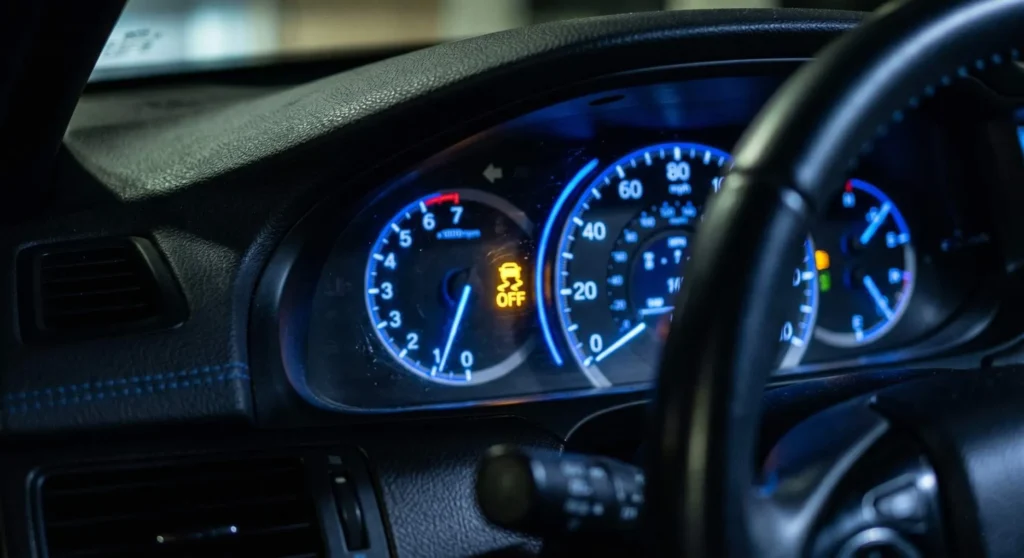
- Verify on the Dash: Look at your instrument cluster. The VSA OFF indicator (a yellow triangle with an exclamation mark or the swerving car icon) will illuminate.
To protect the driver, the Accord’s computer defaults to VSA ON every single time you restart the engine. You must press the button every time you start the car if you want the system disabled. Furthermore, pressing this button only partially disables the system; extreme lateral slipping will still trigger emergency braking. (If your emergency braking triggers randomly on the highway, you may need to learn how to tell which ABS sensor is bad).
Having trouble getting the timing right? Watch this quick video demonstration to see the exact sequence in action:
The Digital Dash Method: 11th Gen Accords (2023–2026+)
If you drive a newer Accord, especially a Hybrid model, Honda has removed the physical VSA button and moved the system into the digital gauge cluster.
To disable the system on modern Accords:
- Use the left scroll wheel on your steering wheel.
- Scroll through the dashboard menu until you reach Settings.
- Select Vehicle Stability Assist.
- Choose the option to Reduce Traction Control.
- The digital dash will confirm that the system is reduced, allowing for wheel spin.(If you are thinking about upgrading to one of these newer hybrid models soon, be sure to review what to look for when buying a used Honda Accord).
The “Pedal Dance”: How to Fully Disable VSA? (10th Gen 2018-2022)
Car enthusiasts and mechanics quickly realize that simply pressing the VSA button does not actually turn the system 100% off. Honda leaves a “safety net” active. If you are tracking the car or putting it on a dynamometer, you must enter “Maintenance Mode” using a sequence known as the Pedal Dance.
(This complete override is especially important if you are at the track and wondering is brake boosting bad for your specific setup).
You must perform this exact sequence quickly after starting the vehicle:
- Start the Engine: Ensure the car is in Park.
- Hold the Brake Pedal: Press and hold the primary foot brake.
- Toggle VSA: Press the VSA button OFF, then immediately press it ON again.
- Engage the Parking Brake: Pull the electronic parking brake switch.
- Toggle VSA: Press the VSA button OFF, then ON again.
- Release the Brake Pedal: Take your foot completely off the primary foot brake.
- Toggle VSA: Press the VSA button OFF, then ON again.
- Press the Brake Pedal: Step on the primary foot brake one last time.
If done correctly, the VSA light and the traction control light will begin flashing on your dashboard. This indicates that Maintenance Mode is active and the electronic nannies are completely dead. Restarting the car will reset everything to normal, without you needing to worry about will touching battery cables together to reset a computer work or not.
Why is My Honda Accord VSA Light Stuck On?
If your VSA light or Traction Control light is permanently illuminated and pressing the button does not turn it off, your system has not been manually disabled—it is broken. When the computer detects a fault, it completely disables the VSA system to prevent unpredictable braking.
This usually happens for three reasons:
- Misaligned Steering Angle Sensor: The car does not know which way the steering wheel is pointed. This is often the hidden culprit if you are constantly asking why does my steering wheel pull to the right.
- Uneven Wheel Rotation: If you recently hit a pothole or are wondering why your car shakes going over 60 mph, a bent rim, severely uneven tire pressures, or a bad alignment will confuse the wheel speed sensors.
- Failed ABS Module or Wheel Speed Sensor: A dead sensor will instantly trigger a hard fault.
Because replacing an ABS control unit or diagnosing electrical faults can be surprisingly expensive, you should immediately run your vehicle’s details through our Free Auto Repair Cost Estimator. This allows you to verify fair local parts and labor pricing for Honda diagnostic work before you walk into a dealership.
Frequently Asked Questions (FAQs)
No. For safety and liability reasons, Honda programs the Engine Control Unit (ECU) to automatically reactivate the Vehicle Stability Assist (VSA) system every time the engine is cycled off and back on.
In dry, predictable conditions, it is fine. However, in heavy rain, ice, or sudden emergency maneuvers, driving without VSA dramatically increases your risk of hydroplaning or spinning out. It should only be turned off when you deliberately need wheel spin to gain momentum in deep snow or mud.
That is the VSA system doing its job. When the wheel speed sensors detect that the front tires are spinning faster than the rear tires, the ECU instantly cuts engine power to regain grip.