
Maintaining optimal suspension geometry is the top priority for safety and for prolonging your tires’ lifespan. Most drivers do not notice subtle steering changes until they result in uneven tire wear and the need to buy new tires at a higher cost. A precise wheel alignment in a Honda Civic can address chassis variations and restore factory handling, as well as improvefuel economy.
When the tires on a vehicle are not completely flat on the ground, the rolling resistance of the vehicle goes up. This translates to the engine being a lot less efficient, and the fuel economy is impacted. Aligning the suspension angles in a timely manner prevents the steering linkages and the ball joints from wearing out.
Delaying this service often leads drivers to wonder how long can you drive with bad tie rods before a complete steering failure occurs.
Credit: www.edmunds.com
Recognizing When Your Vehicle Needs Adjustment
The steering wheel remains the best indicator for assessing suspension health. Driving with an inclined steering wheel on a flat, straight road clearly indicates geometry issues. Experiencing a pull to the left or right while coasting points directly to directional tracking problems. (This constant pulling often leaves drivers frustrated and searching for exactly why does my car pull to the right when driving).
Uneven tire wear frequently reveals underlying camber issues. Excessive wear on the inner or outer tire surfaces exposes improper positive or negative camber settings. Proper adjustment, including a Honda Civic rear wheel alignment, restores parallel tracking. (You can spot these specific camber problems early by understanding exactly why are my rear tires wearing on the inside).
A shaking steering wheel at high speeds signals a severe loss of directional control. Unbalanced tires can cause these vibrations, but misaligned wheels working against each other are the most common culprit.
Resolving these directional control issues immediately increases driving comfort and overall safety. (Should the shaking persist after a fresh alignment, you will need to determine can bad struts cause shaking to isolate the worn suspension components).
Factors Influencing Your Honda Civic Wheel Alignment Price
The location and type of service facility affect the overall price of calibration services. Calibration costs more in urban service centers due to higher operating costs than in rural independent garages. Dealerships are more justifiable in their premium hourly labor costs because they use specialized, calibrated Honda chassis laser measurement racks.
The total price on the rack depends on the severity of your suspension misalignment. Tie rods and struts that are rusty or broken require heating or localized replacement before they are legally adjusted. Unexpected repairs of rusty struts and tie rods lead to a higher overall Honda Civic wheel alignment cost.
In cases of extreme undercarriage rust, mechanics sometimes have to figure out how to remove camber bolts that have seized completely to the control arms.
Use our Free Auto Repair Cost Estimator to calculate the expected repair cost based on your vehicle issue.
Use the Repair Cost Estimator
Analyzing the Pricing Models
You should be ready to pay a little more for a professional laser calibration as you evaluate costs for average wheel alignments. Cost for a wheel alignment ranges anywhere from $134 up to $200 for standard factory Civic models. Independent tire companies sometimes offer tour promotions, which can lower costs for basic adjustments for the front end.
On the other hand, you should know that to get the best level of modern highway stability, all-4-wheel adjustments should be made. The average cost of all-4-wheel alignments is in the range of $150 to $190, so expect to pay more for that.
All-4-wheel adjustments make sure the back end of the vehicle is equally aligned with all steering inputs of the front end, which results in the vehicle being more stable at higher speeds.
For a more precise breakdown of potential repair costs beyond alignment, you can use our Free Auto Repair Cost Estimator to budget for your specific vehicle needs.
| Service Type | Estimated Price Range | Best Application |
| Front-End Alignment | $75 – $110 | Minor steering wheel corrections and solid rear axles |
| Four-Wheel Alignment | $134 – $200 | Routine maintenance and new tire installation |
| ADAS Sensor Recalibration | $250 – $400 | Models equipped with Honda Sensing technology |
How Misalignment Impacts Advanced Driver Assistance Systems?
Today’s cars use a lot of sensors to electronically follow lanes and avoid even minor collisions. The Honda Sensing suite uses a forward-facing camera and millimeter-wave radar to monitor traffic ahead. If a suspension thrust angle takes the car off-center, active safety systems get conflicting data.
Understanding what is an acceptable thrust angle is crucial for keeping these advanced radar systems accurate
The car’s computer thinks the steering wheel is in a straight line, but the suspension is off, and the car is corrected toward the shoulder. With correct Honda Civic wheel alignment, the steering and corrections in the sensors will be in line, which will stop the false warnings for departures and also stop the lane assist from countering the driver.
Lack of this integration will cause what can be a life-saving technology to be a distracting hazard. Make sure that the service center can either use a type of computer that can be plugged in to reset the steering angle sensor after the mechanical tie rods are turned.
The Science Behind the Suspension Angles
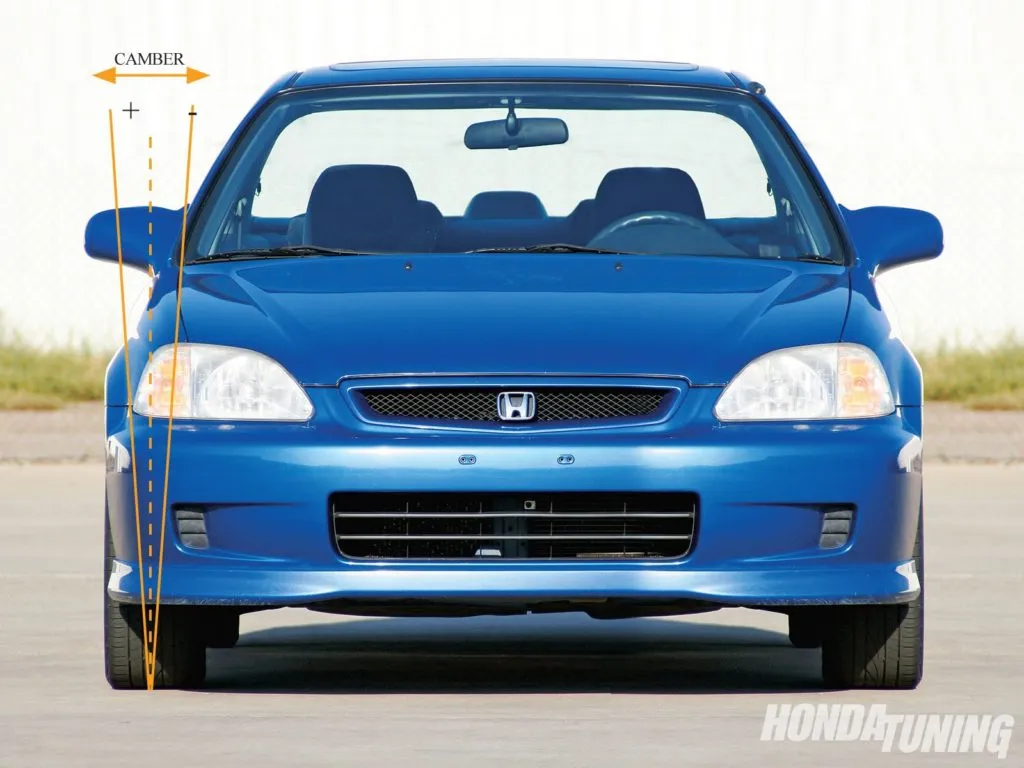
Alignment technicians answer this question using computerized alignment racks that measure three angles: camber, caster, and toe. Imagine a line drawn straight down the center of a car’s underbody. If the tire is tilted to the left, the camber is positive. If it’s tilted to the right, the camber is negative.
High negative camber is beneficial to tire grip during cornering at high speeds, but it can be damaging to the tire and cause wear to the inner side of the tire tread.
Caster is the forward or backward angle of the steering axis as observed from a side view. A positive caster angle aids in the straight-line stability of the vehicle and also the steering wheel’s return to center. If the caster angles are not what they should be, the steering can feel very light and at the same time very heavy, particularly during low-speed maneuvers.
Advancing the toe such that a line is drawn approximately parallel to the toe line can also be the leading edge of the two tires. Too heavily toeing in, for example, leads to a rapid loss of tires due to horizontal scrubbing during contact with a load, particularly an under load. It is for these 3 parameters(in addition to others) that a typical wheel alignment is performed.
Frequently Asked Questions
Recommendations for practice in the industry are to check suspension angles once every 12,000 to 15,000 miles, or about once a year. You must also request a Honda Civic wheel alignment right when you put on your set of new tires, as this protects the tread. Sudden impacts, such as hitting a big pothole or jumping up on a curb, will require you to do a structural check to assess the possibility of further suspension damage.
A set price for software adjustments done by certified professionals usually lies between $134 to $200. Final costs will be impacted by the variations in the cost of local labor, shop costs, and the cost of suspension hardware replacements. Always request a tie rod check-up before the adjustment to see if they are damaged, before you agree to the alignment.
Drastically higher price of misaligned wheels; limited on your emergency handling and braking to the point that most of the time is becoming a real hazard. If there’s an extended distance of highway driving, this will mentally drain the driver by as much as a few hours, and eventually will wear out your tires. You are also putting new strain on the steering system.