
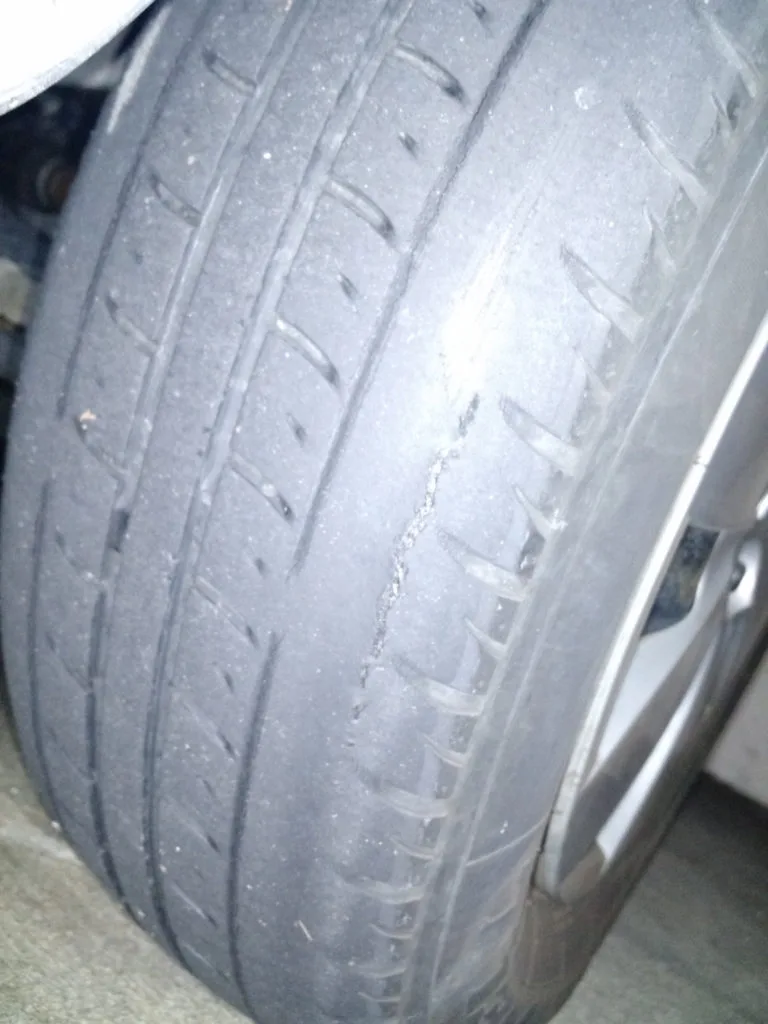

No, you cannot drive on a tire with wires showing. The wires are part of the tire’s structure and provide strength and support. If they are exposed, it means the tire is damaged and could fail while you are driving.
This could cause a serious accident.
Exposed tire wires are a serious safety hazard and should never be ignored. When the steel cords inside a tire become visible, it means the tire’s structure has failed, greatly increasing the risk of a sudden blowout or loss of control while driving. In addition, protruding wires can damage other vehicles or cause injury if they come into contact with someone.
What Does It Mean When Wires Are Showing on Tires?
It’s happened to the best of us – you’re driving along and suddenly you hear a loud pop followed by a hissing noise. You know that can only mean one thing – you’ve got a flat tire. But then you take a closer look and see that there’s wire poking out from the side of the tire.
Now what? Fixing a tire with wire showing is actually not as difficult as it may seem. The first thing you’ll want to do is get your car off to the side of the road so that you can safely work on it.
Once you’ve done that, follow these steps:
- Remove the hubcap (if your car has one). This will give you better access to the lug nuts.
- Loosen the lug nuts with a wrench but don’t remove them just yet.
- Use your jack to lift up the car until the flat tire is slightly off the ground.
- Finish removing the lug nuts and then pull off the flat tire. Be careful not to lose any of the pieces that may have come loose with it (e.g., hubcap, valve stem cap, etc.).
- Inspect both sides of the tire for any nails or other objects that may be causing the leak and remove them if possible . If there are multiple leaks, it’s probably best to just replace the entire tire .
- Take your spare tire and line it up with the empty wheel well . Make sure that the holes are lined up correctly before inserting the lug nuts .
- Hand-tighten each lug nut as much as possible before using your wrench to finish tightening them .
- Lower your car back down to the ground and give each lug nut another twist with your wrench to make sure they’re all secure .
- Put everything back in its place (hubcap , valve stem cap, etc.) and you’re good to go!
Tire Replacement Cost for Exposed Wires
The cost to replace a tire with wires showing typically ranges from $100 to $400 per tire, depending on the vehicle type, tire brand, tire size, and performance rating. Standard passenger vehicle tires are usually less expensive, while run-flat, off-road, performance, or truck tires can cost significantly more. Additional charges may also include wheel balancing, tire installation, valve stem replacement, and alignment services if uneven wear caused the issue.
In many cases, exposed wires are a sign of underlying problems such as poor wheel alignment, suspension wear, overinflation, underinflation, or neglected tire rotation. If these issues are not corrected, the new tire may wear out prematurely as well. This is why professional tire inspections often include checking alignment angles, suspension components, and tread wear patterns before installing replacement tires.
Use our Free Auto Repair Cost Estimator to calculate the expected repair cost based on your vehicle issue.
Use the Repair Cost Estimator
Related Article: Can broken glass pop a car tire?
Is It Safe to Drive on Tires With Wires Showing?
No, it is not safe to drive on tires with wires showing. This condition indicates that the tire’s tread has worn down to the steel belts, which compromises the tire’s structural integrity.
Driving on tires in this state increases the risk of blowouts, loss of control, and accidents.If you see wires exposed on your tires, you should replace them immediately to avoid serious safety hazards. Continuing to drive on such tires is extremely dangerous for you and others on the road.
How Long Can You Drive on Tires With Wire Showing?
It is extremely dangerous to drive on tires with wires showing, and you should not drive at all in this condition. The exposed wires indicate severe tire wear, and the tire is at high risk of a blowout, which can occur at any moment.
Continuing to drive on such tires, even for a short distance, greatly increases the risk of losing control and causing an accident. The safest option is to stop driving immediately and replace the tires as soon as possible.
Related Article: Can you change a tire on a hill?
Can You Drive a Car With the Wires Showing on Tires?
While it is technically possible to drive a car with the wires showing on the tires, it is not advisable to do so. Exposed tire wires can create a number of safety hazards, both for the driver and for other motorists on the road. If the wires are left exposed, they are more likely to be caught on something and cause the tire to come off the wheel.
Why is There Wire Sticking Out of My Tire?
If you take a close look at your tires, you’ll notice that there’s a thin wire sticking out of them. This wire is called the tire bead, and it’s an essential part of your tire. The bead is what holds the tire onto the wheel rim, and without it, your tire would simply fall off.
The bead is made of steel or Kevlar, and it’s incredibly strong. In fact, it has to be strong enough to withstand the pressure of the air inside your tire (which can be up to 120 PSI). The bead is also coated with rubber to help create a seal between the tire and wheel rim.
So why does the bead have a wire sticking out of it? Well, that wire is actually part of the reinforcing structure of the bead itself. And without that reinforcement, the bead wouldn’t be nearly as strong.
So next time you see that wire sticking out of your tire, don’t worry – it’s supposed to be there!
Related Article: What is tire light load inflation?
How Can You Tell If a Tire is Safe to Drive On?
It is important to regularly check your tires to ensure they are safe to drive on.There are a few ways you can tell if a tire is safe to drive on:
- Check the tread depth of the tire. The minimum tread depth for a passenger vehicle is 4/32 of an inch, or 3.2 mm. You can check the tread depth by inserting a penny into the tire tread groove with Lincoln’s head upside down and facing you.
- If you can see all of Lincoln’s head, the tread depth is less than 4/32 of an inch and the tire needs to be replaced. If part of Lincoln’s head is obscured by the tread, then the tire has enough tread depth and is safe to drive on.
- Look for signs of wear and tear on the tire surface. If you see any cracks, cuts or gouges on the sidewall or tread surface, this is an indication that the tire is no longer safe to use and should be replaced immediately.
- Inspect the Tire Pressure Monitoring System (TPMS) light on your dashboard. If this light comes on while you are driving, it means there is an issue with one or more of your tires and they need to be checked as soon as possible.
- Check for bulges or blisters on the sidewall of the tire.
These indicate that there may be internal damage to the tire and it could fail suddenly while you are driving.
Related Article: Why do tires have whiskers?
Conclusion
If you have a tire with wires showing, it is not safe to drive on. The wires are there to provide reinforcement for the tire, and if they are showing, it means that the tire is severely damaged. Driving on a tire with wires showing can cause the tire to fail completely, which could lead to an accident.
If you have a tire with wires showing, it is best to replace it as soon as possible.